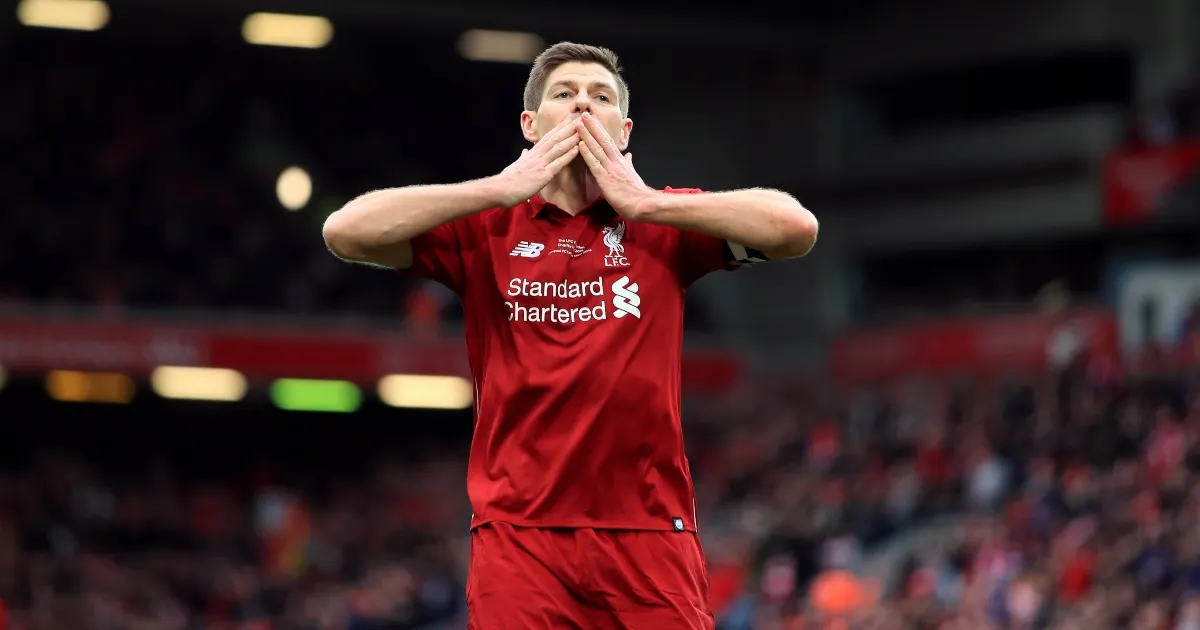
Anfield has always been a sea of red whenever Liverpool plays. Initially chasing a one-point gap between the Premier League leaders Manchester City, the Reds saw a disappointing 1–1 draw against Tottenham Hotspurs on May 8th, their title hope dampened with only three games remaining. It had taken three long, agonising decades for a historical club like Liverpool, which had won the 18 top-flight championships and crowned as the best in Europe six times, to claim another top-division glory, which was also their first Premier League title, in 2020. They came so close in the previous season, amassing a total of 97 points that would easily clinch the title in any other season had it not been Pep Guardiola’s invincible City that collected one point more. When the Reds finally won the league in 2020, their captain Jordan Henderson, who took over the armband after Steven Gerrard’s departure in 2015, paid tribute to his predecessor by saying that, “No one can replace Steven Gerrard at this club. I was devastated in 2014 that we couldn’t get over the line for him. This one is quite personal for me and to do it for him is quite big.”
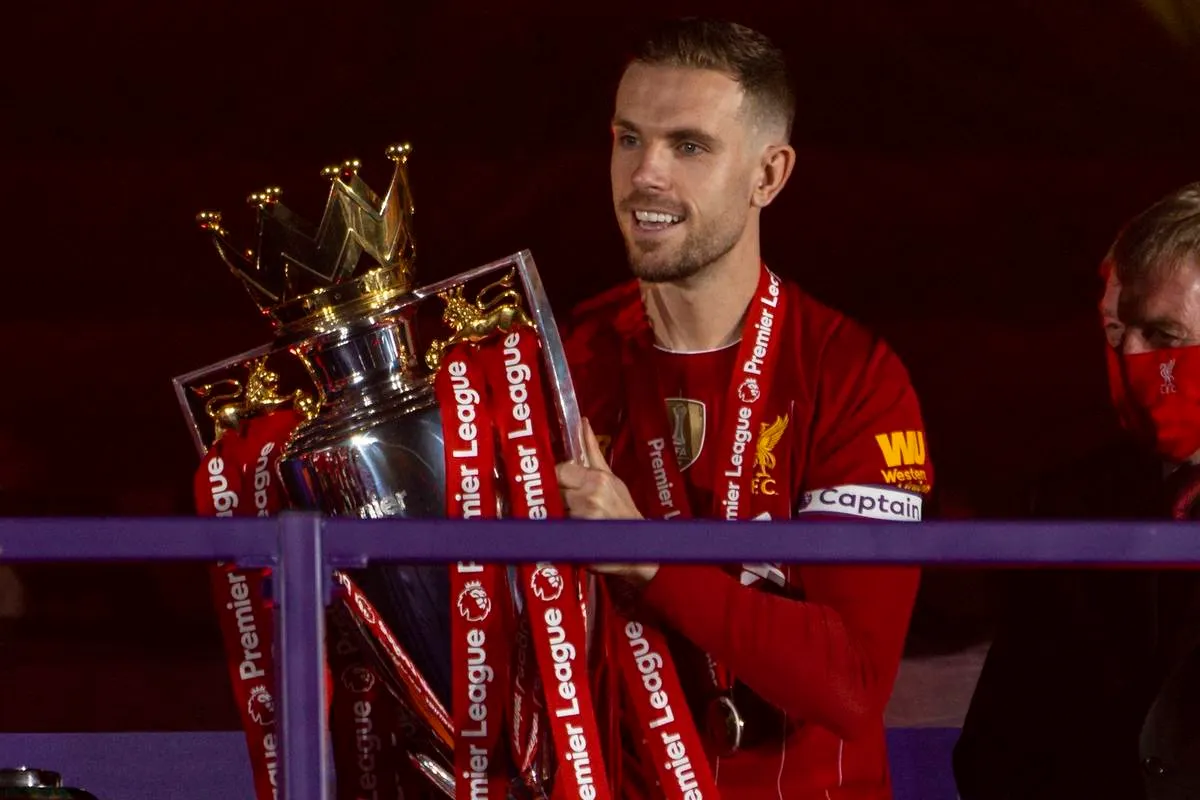
Jordan Henderson won the Premier League title with Liverpool in 2020.
Of all people, Gerrard should know the best how missing out on such a close margin felt like. That near miss in 2014 still haunted Gerrard as much as it had haunted Henderson, for it was he who made an irreparable slip that allowed fellow title-contenders Chelsea to extend their lead and cost their title dream in the end. Earlier that season when they had beaten tough opponents like Arsenal, Manchester United, and Manchester City in a stylish fashion, the trophy seemed just within reach.
“It was the toughest moment of my career by a mile,” says Gerrard. It feels strange to meet Gerrard in Birmingham but not in Liverpool, since he is now the manager of Aston Villa, leading them out of the relegation zone. He ordered a pint of Birmingham’s signature Bathams Bitter for me at the Villa Park hospitality, yet his figure is perfectly kept as if he could still step out onto the grass court and play.
“At the end of the game, I just wanted to be under the ground. When we left Anfield, I was in the back of the car. We were on the way home and the tears were rolling down my face. It was killing me. I had that feeling you get when you’ve lost a family member, that’s how bad it felt. The tears kept coming. I was 33 years old and I hadn’t cried for years.
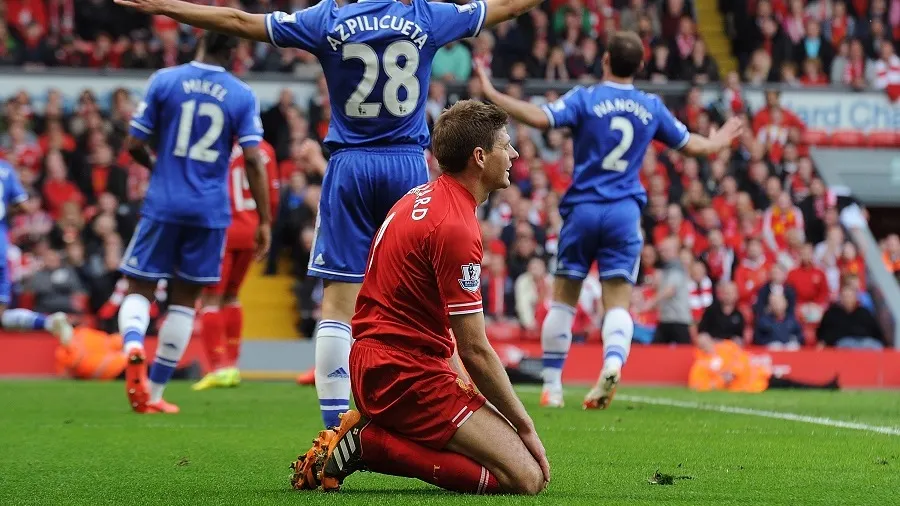
Gerrard’s slip against Chelsea cost their title in 2014.
“There’s not a day that doesn’t go by that I don’t think about what if that didn’t happen. Would things have turned out different? Maybe it might of, I don’t know.” Despite winning the Champions League, the UEFA Cup, three League Cups and two FA Cups for the Reds, the Premier League trophy was Gerrard and every Red’s ultimate dream and deepest regret. In 2014 they missed out on the title by two points, in 2009 by four, and in 2002, seven.
Yes, Gerrard had been around for that long. He had been with the club’s youth academy since the age of eight and made his senior debut in 1998 as a late substitute against Blackburn Rovers, the same year in which his fellow academy graduate Michael Owen established himself as an international superstar at the World Cup in France. In 1998 there were no wrinkles on Gerrard’s forehead, and he was outshone by Owen. In his 17-year-long allegiance to the club and especially those three second-best seasons, people remember the goals galore scored by the wunderkind Michael Owen, ‘El Niño’ Fernando Torres, the buck-teethed Luis Suárez, and perhaps their latest home-grown goal-scoring machine Raheem Sterling, but it was Gerrard who had telepathic connections to these strikers and wingers and struck incredibly precise long-ranged balls for them to put into the back of the net.
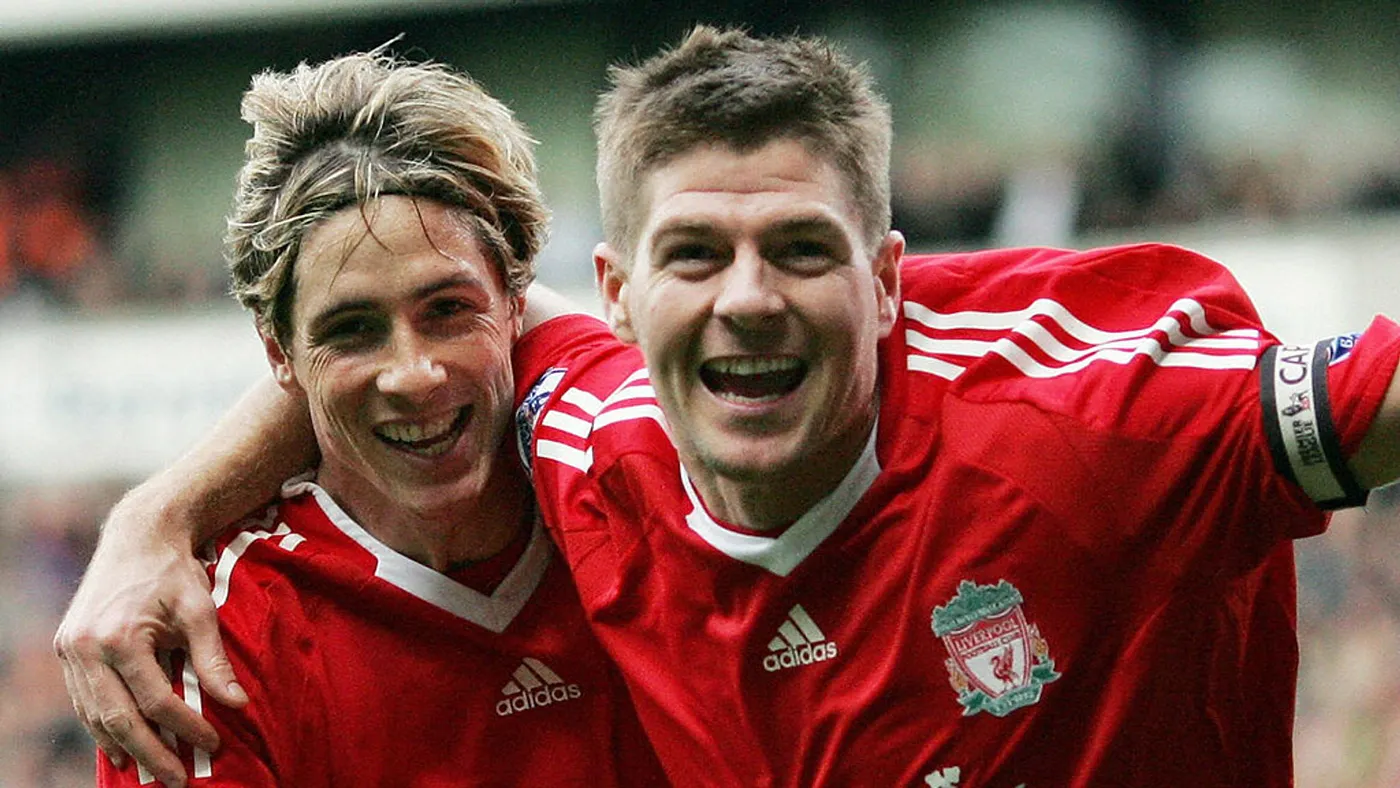
Fernando Torres and Steven Gerrard were a formidable pair.
(I for one was a fan who hadn’t appreciated his presence enough; I’ve bought jerseys of Owen, Torres, Suárez, Coutinho ‘the Little Magician’, and even defensive midfielder Dietmar Hamann, whom I liked simply because his last name resembles Tim Henman, my all-time favourite sportsman on Earth and another tragic hero who had been carrying Great Britain’s hope of winning the first Wimbledon men’s singles title since 1936, only to be defeated by the subsequent champion in four semi-finals, but not Gerrard until the very end of his career — and it was even an away shirt!)
Sadly, those premium strikers and wingers eventually left Liverpool for more money or trophies elsewhere; Michael Owen left for Real Madrid in 2004, Fernando Torres for Chelsea in 2011, Luis Suárez and Philippe Coutinho for Barcelona (Suárez may be exempted because his wife’s family lived there) in 2014 and 2018 respectively, and Raheem Sterling for Manchester City in 2015 (this greedy kid was simply unforgivable). Some of them did enjoy the success they longed for, while others failed to get enough minutes on the pitch as they would have liked to. Loyalty has become a rare virtue in modern money-driven football and Gerrard was among one of those endangered one-club players like Francesco Totti and Paolo Maldini.
“There’s so much money in football now, because of the television deals, and it seems to be getting worse,” Gerrard says, as hand raised pork pies and apple chutney were being brought to our table, epitomizing the Midlands’ native produce. “I think we’ll see players moving an awful lot more, because agents will always push for the next move. My own focus has always been football. It’s something my mum and dad handed down to me — the idea that you should just be the best you can be and everything else will take care of itself. You avoid becoming greedy. You concentrate on becoming a good footballer, rather than a personality or a brand.”
Rolling back the clock to December 11, 2021, the Kop welcomed their legendary ex-captain back five and a half years after his departure, this time as an opponent, giving him an emotional standing ovation before kick-off, although their reigning Egyptian King Mo Salah sealed the game off mercilessly with a converted spot kick. After the 1–0 defeat at Anfield, Owen, now a TV pundit, asked Gerrard in the post-match interview: “I must admit I hated going back to Anfield to play — what were your emotions?”
“If I played for Manchester United, I’d hate coming back here!” replied Gerrard with a wry smile, scorning his former best friend’s infamous transfer to their archrival.
Watching these two of my childhood heroes standing side by side in front of the camera again, it was as if they were their energising, captivating coming-of-age selves again in the treble-winning season of 2001. At that time, it was the young, lightning-quick Owen who tore apart defenses easily, who received the Premier League’s golden boot twice by the age of 19, who single-handedly turned against the tides against the mighty Arsenal in the FA Cup final, and who won the Ballon d’Or at 22, younger than either Cristiano Ronaldo or Lionel Messi, that made me a faithful Liverpool fan, an admiration shared by Man City’s key playmaker, Kevin De Bruyne (it was such a pity that Liverpool couldn’t afford to buy him). After securing a League Cup trophy against archrival Manchester United with both of their names on the scoresheet in 2003, Gerrard was named captain in the following season, but a trophyless 2003–2004 campaign saw transfer rumours speculating again whether the gems of Anfield would be lured elsewhere. Owen once said that it would be a catastrophe if Gerrard left Anfield, but he it was who eventually left for the Bernabéu in the summer of 2004.
“I just assumed we were going all the way to the top together,” Gerrard rues, “It was always me and him.”
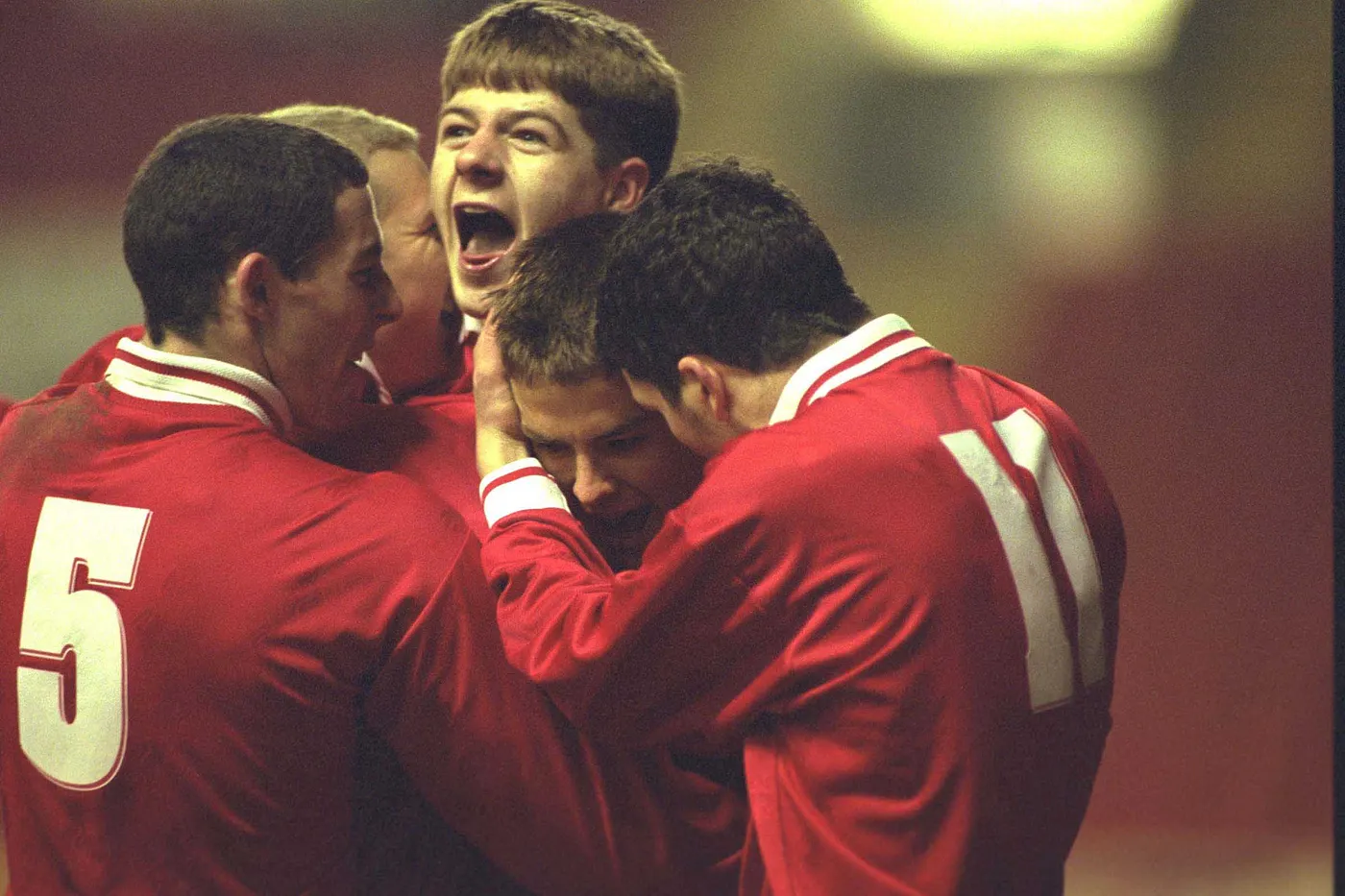
Michael Owen scored against Manchester United in the FA Youth Cup in 1997.
“It’s the lure of going and winning, being what you’ve always wanted to be, growing up,” explained Owen, “If I say no, I’ll probably think what would that have been like for the rest of my life. I’ve just got to try it.” But his teammate Jamie Carragher disagreed. “I was in the room with Mike when he got the call, and my first words were, ‘I wouldn’t go.’ I was always a big-picture person, like, ‘How will people see you at the end?’ I can get it. You may want to play with the greatest players in the world, but it’ll create a divide that may not be able to be ever healed.
“Is it worth it for that?” Carragher asked.
Despite Owen’s wish for a return to Anfield after an unsuccessful spell in the Spanish capital, he joined Newcastle United on a four-year deal instead, and then went on to join United in 2009. “I have to be honest and say I was very surprised he chose to sign for Manchester United,” laments Gerrard. “Michael enjoyed legendary status at Liverpool but that has been diluted because of the move he made. Only Michael knows if he got that decision right.”
The dessert was poached pear with stilton and frosted pecans, another dish that celebrated the Midlands on a plate, and it tasted divine. After Owen’s departure, it was left to Gerrard to carry the entire city’s passion and expectations on his shoulders alone, maturing into an all-rounder who can tackle, pass, and, more importantly, score goals that mattered. “ Liverpool captains always deliver. They have to,” says Gerrard. The following season saw Gerrard taking Liverpool to the summit of Europe, first by sending them into the round of 16 through a “stunning half-volley, speared majestically from the edge of the area,” according to The Guardian, the very goal that they needed to qualify.
“I’d be a liar if I didn’t say I thought we were down and out at the break. They were spoiling the game and were strong defensively, so there was a mountain to climb at half-time,” Gerrard admits.
And then there came the ‘ Miracle of Istanbul ’, the night which Liverpool staged a remarkable comeback after being destroyed by an impeccable AC Milan side well before half time. “We’d punched way above our weight to get there, but we had 45 minutes to try and get some pride back. And I think the fans, at least, deserved that. So I felt that responsibility. It’s up to me,” recalls Gerrard.
When Gerrard’s header did pull one goal back, he did this urging hand gestures to his teammates and the travelling fans, begging them to believe that it was not just a consolation, and soon they scored two more within a six-minute stretch, defended heroically until the end of extra time, and finally got the better of Milan in the penalty shoot-out.
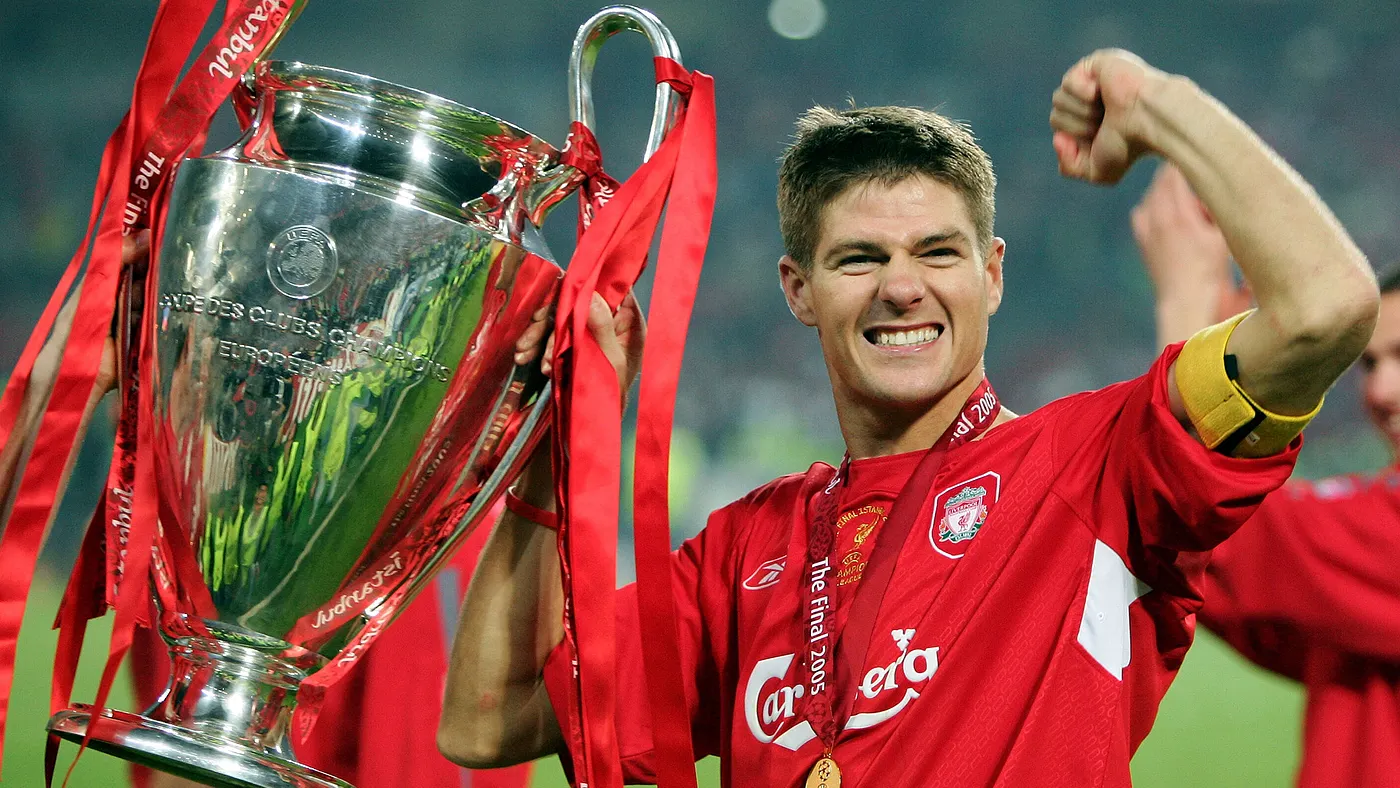
Gerrard led Liverpool to European glory in 2005.
“We went as crazy as you would expect. We yelled and danced and ran around like idiots. I look back now in amazement. Was that really me? I celebrated like I deserved to celebrate. Correct me if I’m wrong, but have you ever seen a better Champions League final? Every single one of Milan’s players was either world class or very close to it. They were a better team than us, but we beat them.
“It was not just luck. The big moments in the second half went our way but, after we got back to the dressing room, I saw how much we had given. There were cuts everywhere, bruises, ice, bandages, sweat, dirt and plenty of tears. It looked like we had been to war,” Gerrard smiles. We finished the dessert with a shot of espresso and ordered another round of bitter.
But inside Gerrard’s born-and-bred red heart, there had been times of temptations. When big money was pumped into the business and Russian oligarch Roman Abramovich took over West London-based club Chelsea, buying whichever player he wanted at whatever price, to end the barren spell of first-division title at Liverpool became even more challenging. “My natural instinct is to always defend the club, but there was a part of me that knew that we weren’t good enough. How am I gonna win these Leagues and Champions Leagues?” Gerrard confesses. Moreover, Chelsea’s manager at that time, José Mourinho ‘The Special One’, had been showing great admiration to Gerrard and desperate to bring him in, whereas Stevie was feeling not appreciated enough by his Spanish manager Rafael Benítez. Six weeks after he had brought the fifth European Cup glory back to Merseyside, he submitted a transfer request that shocked the red half of city. The Kopites felt betrayed and burned the shirts bearing his name in front of TV cameras. “Whatever the reason … Chelsea? The bastard son of modern football. Why would a Huyton lad, Liverpool Football Club to the heart, want to go there?” asked Gareth Roberts, editor of The Anfield Wrap magazine.
“My dad asked me a simple question: ‘Would it mean more to you to win two or three trophies with Liverpool than double that number with Chelsea?’ I wasn’t thinking about Chelsea then. I was thinking only of Liverpool. Dad understood,” Gerrard recalls.
“He said to me, ‘You can’t change what you are, the way you’ve been brought up. You’re a Scouser. These fans adore you. You’re everything to them. You’re their hope and their dreams every single day. Liverpool’s in your heart. Forget what’s in your head. If Chelsea are in your head, that’s just a noise. Remember where you’re from. Remember who made you. Don’t walk away from the club that you love.’
“I think there’s a lot of people in the game that believe I made the wrong decision, but they don’t know my feelings. Nine times out of ten, maybe the right thing might have been to go. But I’m not one of the nine. I’m the one. And I never regretted staying at Liverpool my whole career in England.”
John Williams, a witness of the Hillsborough disaster who has been studying soccer as a sociologist for the past 30 years, concluded that “There are lots of ways in which people could say that Steven Gerrard’s career is not measured up to what a player of his talent ought to have had. I think he’d have to accept that. But the thing that he has, which very few players have, is the deep love and respect of people from the city in which he was born. He is an emotional person, like many people in the city feel themselves to be. So he’s part of that order which says, ‘How I feel is more important than what I win or what I can earn somewhere else’. And that’s a big message.”
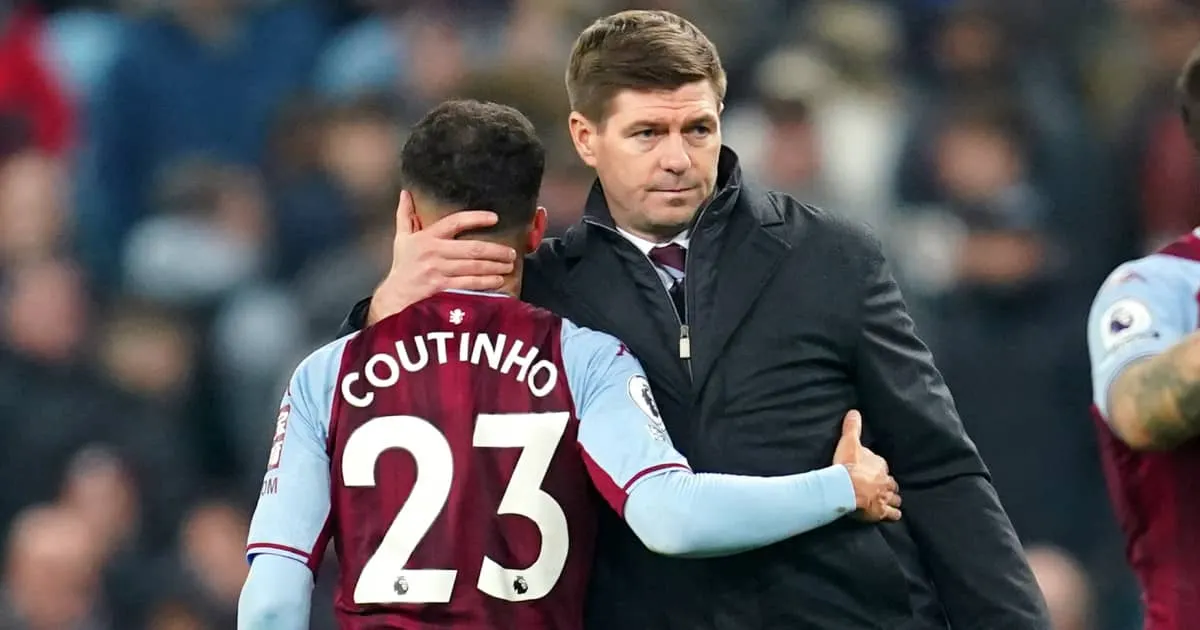
Gerrard brought former teammate Coutinho to Aston Villa.
Gerrard took a quick glimpse at his watch. It was about time to leave for the training ground. When he decided to bid farewell to his beloved city after giving everything he could and leave for America, the manager at that time, Brendon Rogers, described Gerrard as “a guy who is very much about looking after his people”.
“He’s had a number of opportunities to move to prestigious clubs but Liverpool is his home, he grew up around the corner, this is his place and these are the people he loves. What he’s given to this city, politicians haven’t given to this city. All the work he does for local hospitals and charities goes unheralded. He is a wonderful symbol for the people here and an incredible icon of the club. You see in Barcelona they have the quote ‘more than a club’. You look at Steven Gerrard and he is more than football,” said Rogers.
In the States Gerrard enjoyed a short period of Major League Soccer without the spotlight that he detested, being a ‘Z-lister’ that enabled him to relax with his family, but eventually he returned to Liverpool as coach of the youth academy in 2017. “I’ve had an incredible journey. I’ve had my time. But I still think I’ve got unfinished business, and I want to give back,” said Gerrard when he returned to Liverpool as coach of the youth academy, “I often say to myself, ‘Why do you want to go back into the pressure situation, and why do you want to go through all those emotions?’ But I don’t feel my journey is complete.”
One of the teenagers in the academy who idolised him as a boyhood hero, Trent Alexander-Arnold, was described by Gerrard as a ‘beauty’ and was “driven to fulfill that promise”, eventually emerging as one of the world’s finest full-back, playing an indispensable role in the Red’s Champions League and Premier League title-winning team with his precise assists and sensational free-kicks, carrying on Gerrard’s legacy to some extent.
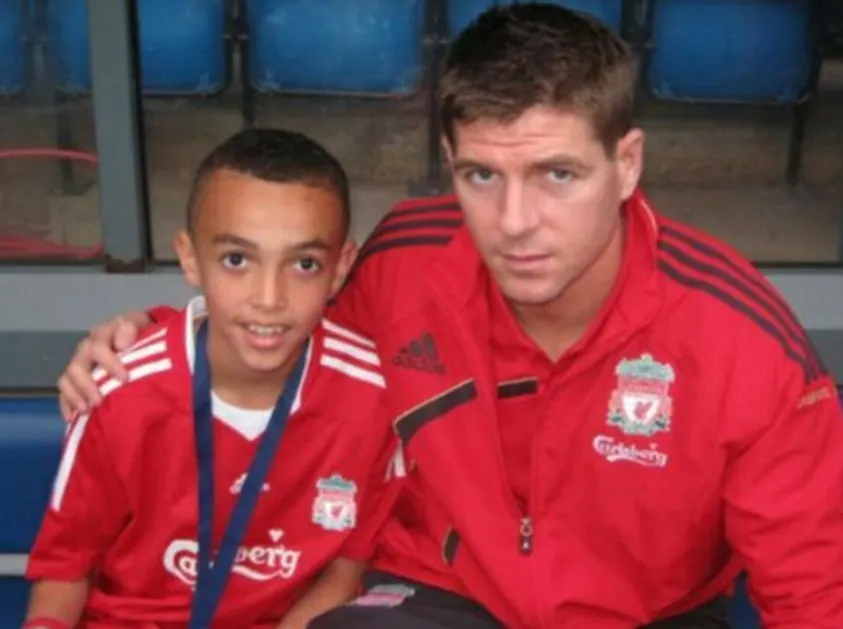
Young Trent Alexander-Arnold with Gerrard.
After cutting his managerial teeth at Glasgow and winning the Scottish Premier League with the Rangers in 2020, Gerrard was appointed as successor to Dean Smith at the Villa Park amidst the turmoil left by Villa’s departed captain, Jack Grealish (and yes he went to Man City). Liverpool still have a glimpse of hope for an unprecedented achievement of a Quadruple season. Now that Aston Villa plays two decisive fixtures against Liverpool and City near the end of the title race, I believe many Liverpool fans, including Jamie Carragher and Michael Owen, are thinking about the same thing as I am: Stevie, we’re counting on you.
“We’ll see,” beams Gerrard.
(This interview never really happened. It’s imaginary.)